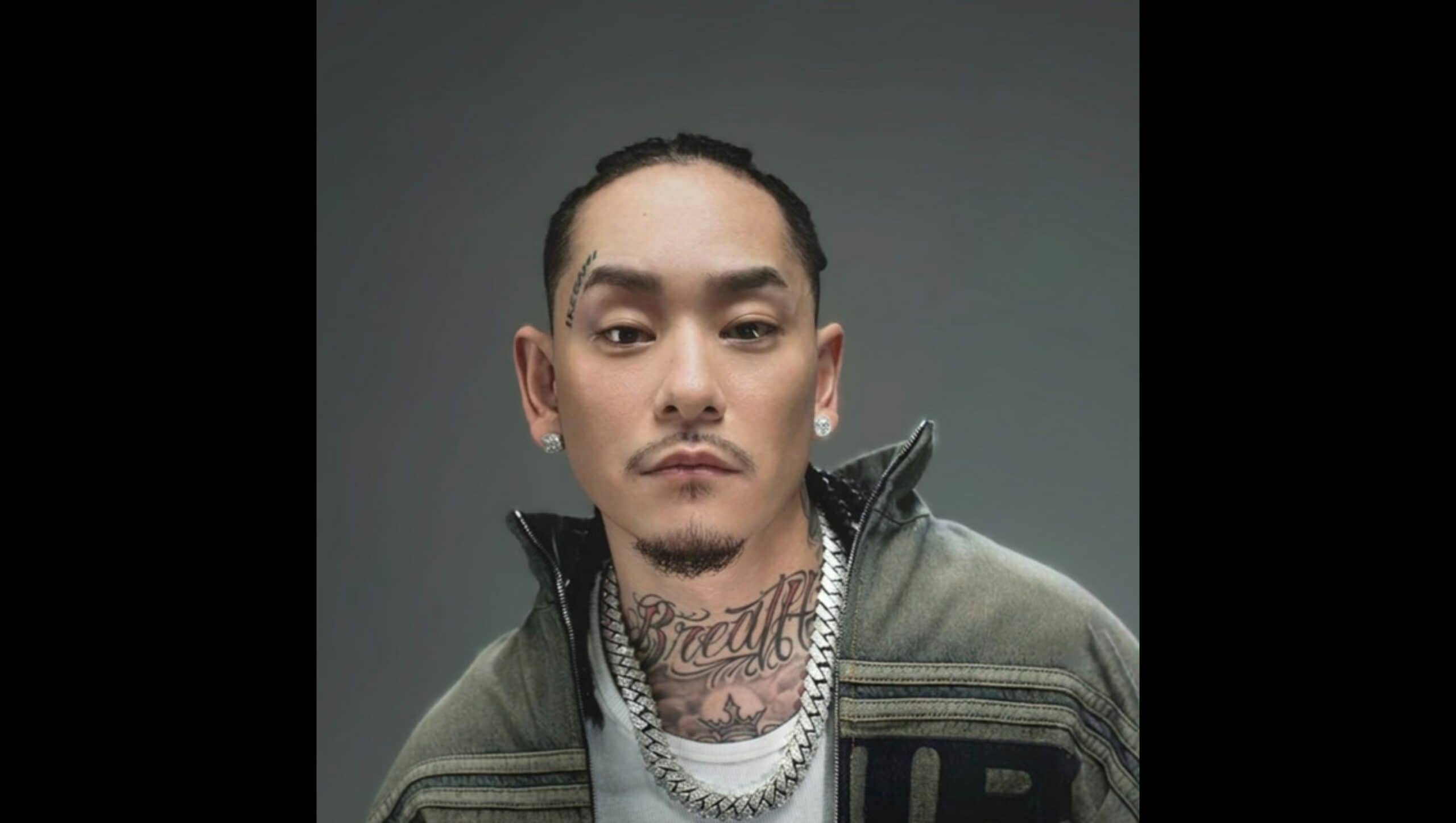
BAD HOP ended at the Tokyo Dome on February 19, 2024. Eight guys from Kawasaki, ten years built without a label or an agency behind them, closing it out with one last sold-out show. Bark was one of them, the deepest voice in the crew, the member who always held a particular space in the group: less in the spotlight than T-Pablow or YZERR, but unmistakable from the first bar. More than a year later, Bark is back on his own. And he’s moving fast, even if the solitude of the studio weighs on him more than he expected.
From Ikegami to BAD HOP
Bark, born Yuki Hinohara, was born on April 18, 1995, in Kawasaki, in the Ikegami district, on the edge of the city’s industrial zone. The area has a reputation in Japan: factories, polluted air, and a level of safety that’s nothing to brag about. That’s where he grew up alongside the people who would become his groupmates. He’s known T-Pablow and YZERR since kindergarten, and he says their mothers were already going to the same hospital before they were even born. As a kid, he was loud, restless, and always wanted to be outside, but rap wasn’t an obvious path for him.
The turning point came from T-Pablow. After a trip to the United States that left him completely changed and hooked on hip-hop culture, T-Pablow came back to Kawasaki and told the group, “We’re doing rap now.” Bark took it seriously after watching his friends freestyle at a local club. Something clicked that night. His stage name came from T-Pablow, too, and the story behind it has an edge to it. The name was originally meant for another friend in the group, who got arrested before he could pursue rap. T-Pablow turned to Bark instead: “Why don’t you bark a little?” Bark kept the name. He says he likes it for being simple, a relief from some of the more dated or overdone stage names other rappers still carry around.
In 2014, this group of childhood friends formed BAD HOP. Eight members, all from the same part of Kawasaki, with no record label backing them. Bark quickly stood out as a distinct voice in the crew, low, steady, rooted in the street. The group’s first album marked its entrance into the game. The decade that followed took them to the Budokan, sold out the Yokohama Arena, and brought them on tour across Japan.
What Bark describes about that period has nothing glamorous to it. He compares the group’s recording sessions to a kind of self-imposed lockdown, with members sleeping on the studio floor to keep producing without a break. In the weeks leading up to the Tokyo Dome show, he barely ate and barely slept. His weight dropped to 55 kilos. He doesn’t hide the chaos in how he lives. He describes himself as a walking pile of bad habits. During heavy production periods, one meal a day is enough, because eating makes him drowsy and breaks his focus. Cooking isn’t part of his routine at all: even cutting vegetables or boiling water for instant noodles feels like more trouble than it’s worth.
Bark Life after the group
The breakup, announced in May 2023 and made official at the Tokyo Dome in February 2024, left a gap. Bark went straight from an intense, collective way of working to solo work, and the contrast shows. He admits to feeling real loneliness since then, a feeling that can tip into negative thoughts when he finds himself alone in the studio, without the other members around to carry the project together. His answer came in 2025 with South Side Story, his first solo album. The title points straight back to his roots in Kawasaki, south of Tokyo, south of his own story. With this project, outside the group’s framework, he proved he could hold his own as a solo MC.
His writing process has shifted with this new phase. He no longer writes lyrics out ahead of time the way he used to: now he lays down lines directly over the beat, one at a time, in the booth, to keep things raw and direct. To transcribe his lyrics afterward, he uses ChatGPT, finding the actual writing tedious. For inspiration, what he calls his “savings” of lyrics, he needs to walk: that’s when the ideas come. His favorite line right now comes from his upcoming solo album, a double meaning playing on the words for a sharpened pencil, the soul, and a pen. 2026 has kept the momentum going. February brought the “Sorry for Mama” video. April brought “All in for One” with SEEDA. May brought “Breath & Soul” with Ashley. Then, in early June, “Aqua-Line“, with COBE J and Money Jack, announced a new project: the mixtape Bling 2 Tape.
The release of that mixtape on June 15, 2026, came with a promotional stunt that broke from the usual playbook. Bark put out a phone number on social media. Calling it played fans a voice message from him, plus an unreleased snippet as a bonus. The number took around 28,000 calls in two days, with more than 16,000 unique callers. At the physical event tied to the release, around 250 fans lined up in the rain, some traveling from as far as Hokkaido or Osaka, some bringing their families. Bark posed for photos with every single one of them. The CD-shaped item handed out came embedded with an NFC chip, unlocking an exclusive track and content meant to expand over time.
What’s coming next
Bark’s summer and fall 2026 calendar points to a packed solo schedule. A solo date at CLUB CITTA’ in Kawasaki is set for October 11, with tickets on sale since June 19. He’s also on the bill for several group shows, including an early-July date at Toyosu PIT with YZERR, Tiji Jojo, and others, plus an August date at K-Arena Yokohama on a lineup pulling together a large chunk of Japan’s current hip-hop scene.
Bark built his reputation on a formula that’s easy to describe and hard to pull off: a deep voice you recognize within seconds, a world rooted in the reality of Kawasaki, and the ability to show up on other people’s tracks without ever sounding like a second-tier feature. That’s the same foundation he’s building on now, solo, still living about as unstructured a life as ever, with a loneliness he no longer hides but one that seems to be feeding his writing rather than slowing it down.
Now listen to our playlists on Spotify!
Updated every two weeks