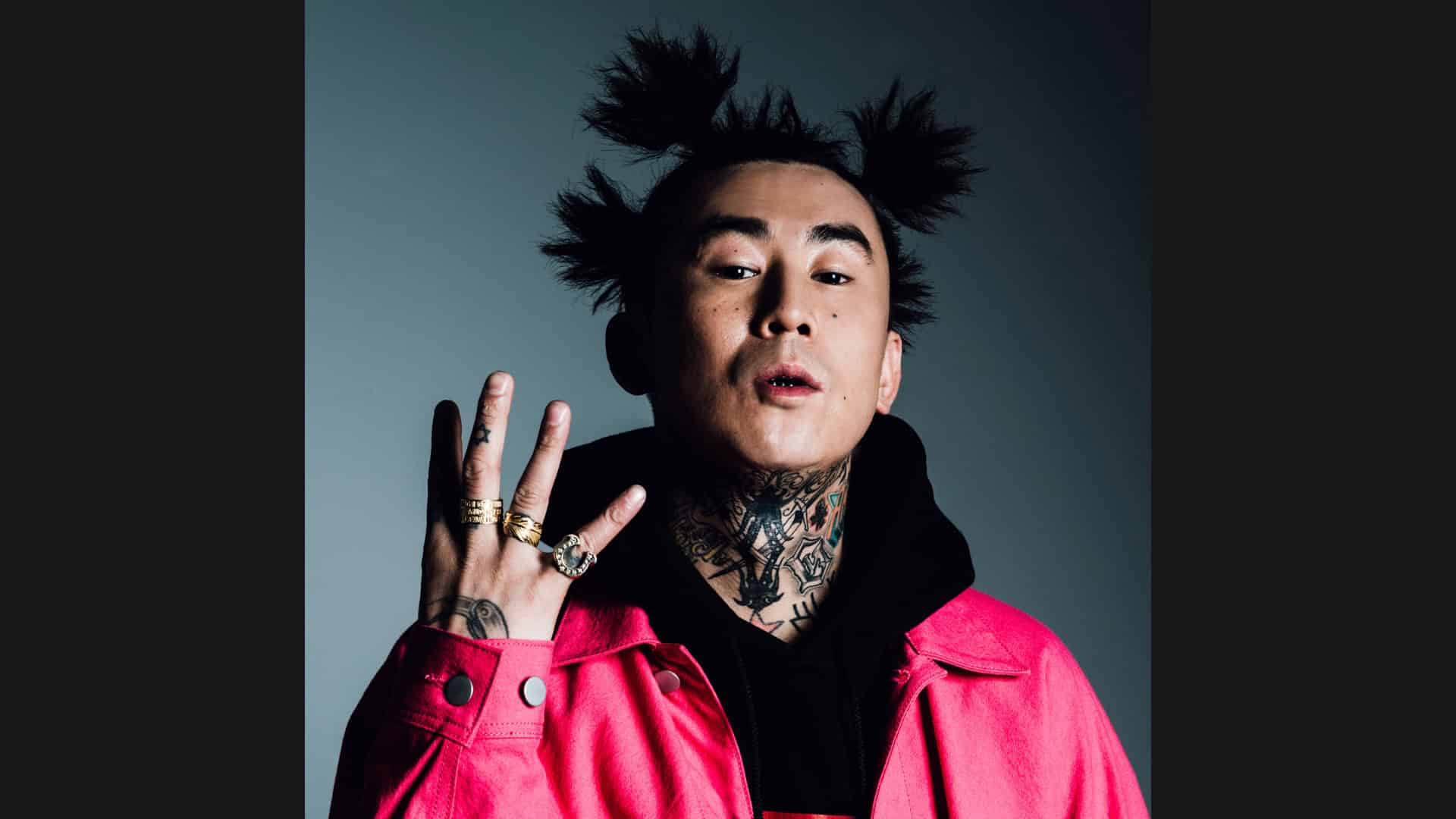
The Mukōjima housing project in Kyoto’s Fushimi ward has a bad reputation. Not as a figure of speech: fights are routine, families live in low-income public housing, and the horizon for kids growing up there is narrow. ANARCHY, born in Osaka in 1981 and moved there at age three, knows this from the inside. His parents divorced while he was still in elementary school. He was raised by his father, a tattoo artist and rockabilly guitarist. The home wasn’t destitute, but it was hard.
At fifteen, ANARCHY started rapping. A year later, he became the leader of a motorcycle gang, accumulated fights, and at seventeen was convicted under a charge that barely exists in modern Japanese law: dueling. He spent one year in a juvenile detention center. It was there, in front of a television, that he saw ZEEBRA perform “MR. DYNAMAYTE”. ANARCHY would reference that moment years later on his track “K.I.N.G.“: Zeebra on the detention center TV screen. After that, he started writing lyrics on the center’s computer. The texts were erased when he left. He says now that the time wasn’t wasted.
From Ghetto Day’z to Billboard Live Tokyo
Out of detention, ANARCHY found that the Kyoto crew he’d been close to, Maguma MC’s, had reorganized without him. He stepped back from them. In 2003, he released a solo EP, Ghetto Day’z, which drew attention well beyond the city. RYUZO from Maguma MC’s came back to invite him to join R-Rated Records, the label he was about to launch. ANARCHY agreed and was part of its founding.
In 2000, before his detention, he had formed the group RUFF NECK with JC, NAUGHTY, YOUNG BERY, and DJ AKIO. The crew picked back up, and ANARCHY multiplied features with the Nagoya underground scene and producers across the country. In 2005 came the single “ROB THE WORLD“. In 2006, the full album of the same name: Rob The World. For an independent release, the sales were out of the ordinary. Music Magazine and Riddim both listed it among the year’s best albums. In 2008, he published an autobiography, Itami no Sakubun (“The Composition of Pain”), through Poplar. The same year brought his second album, Dream and Drama. In 2011, the third, Diggin’ Anarchy, was co-signed with legendary DJ MURO. That year, he became the first Japanese hip-hop artist to perform a solo show at Billboard Live Tokyo.
Avex, a film, and back to independence
In 2014, ANARCHY signed with avex through the CLOUD 9 CLiQUE label, releasing NEW YANKEE, his first major-label album. KOHH appears on “Moon Child“, materializing a connection often noted by observers: two rappers with contrasting styles and overlapping life stories. Complex captured this in its list of 25 Japanese rappers to know. BLKFLG followed on Rhythm Zone in 2016, then The King in 2019, an album of thirteen tracks with thirteen rappers, sold for 13,000 yen, released on March 13th. That same year, he directed WALKING MAN, a film starring actor Shuhei Nomura. ANARCHY wasn’t simply attached to the project as an artist; he was the director. In 2018, he founded his own label, 1%|ONEPERCENT, launching its first artist, WILYWONKA. NOISE CANCEL came in 2021, his eighth album. My Mind, his first solo EP, in 2023. LAST in 2024. CREST in 2026, with the single “Flight Mode” arriving in March.
What runs through ANARCHY’s work since the beginning is a specific address: to people living in precarious conditions, not as a sociological subject but as a lived experience. His lyrics deal with childhood abandonment, poverty, violence, downward exits, and slow reconstruction. His delivery, unhurried and slightly muffled, sits in contrast with the density of what he’s saying. As Complex put it, there’s a constant gap between form and content, and that gap is what makes his rap stick. At 44, ANARCHY has accumulated thirty years of activity, a label, a film, an autobiography, and a catalog spanning every phase of Japanese hip-hop since the late 1990s. Mukōjima remains the fixed reference. He has never really left it behind.
Now listen to our playlists on Spotify!
Updated every two weeks