
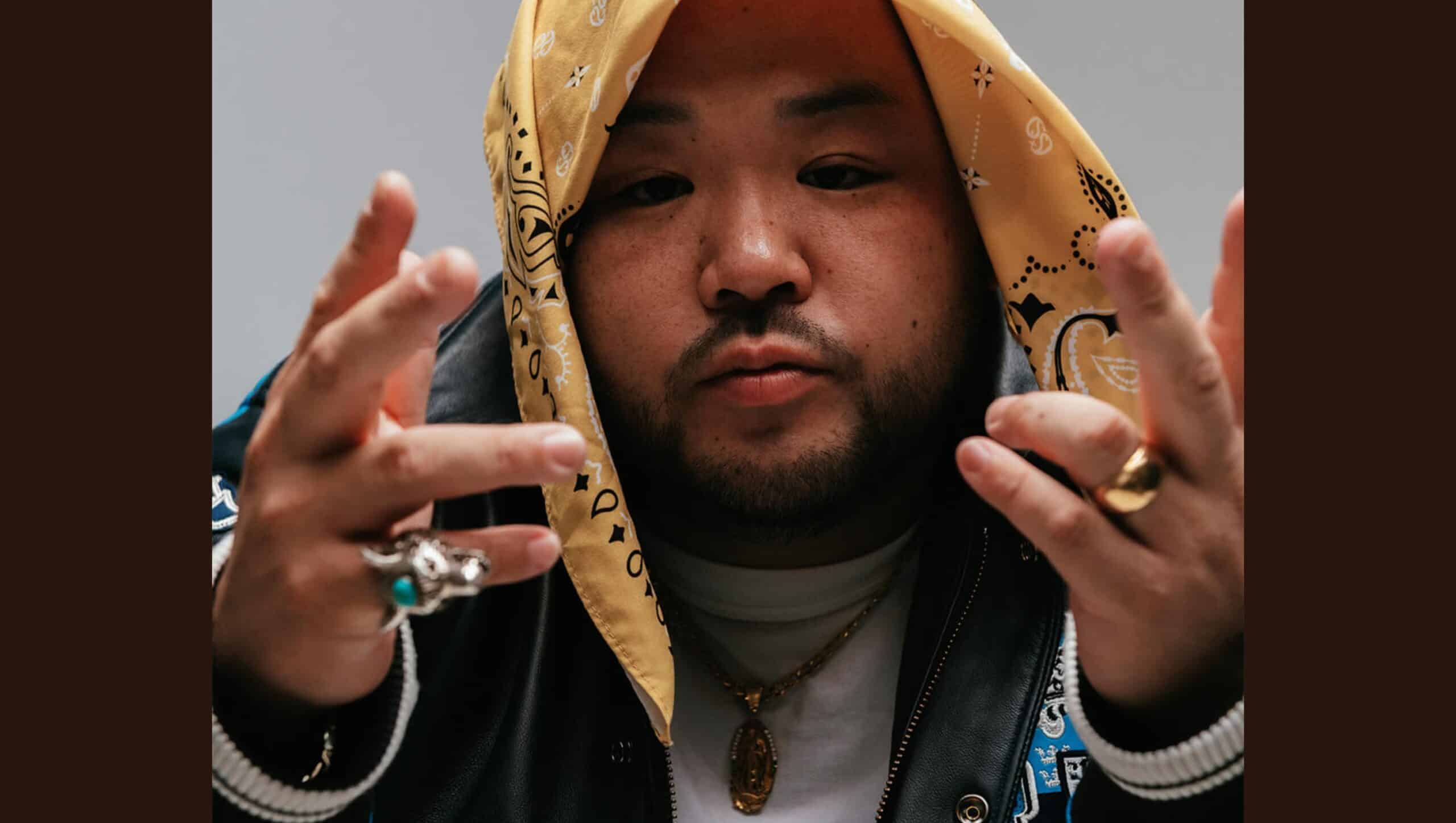
Some rappers build themselves a legend. C.O.S.A. did the opposite from the start: no revealed birth name, no staged origin story, just a writing discipline he’s kept since his teens and a reputation built feature by feature, without ever forcing the door open. C.O.S.A. was born in 1987 in Chiryu, Aichi Prefecture, and has been based in Nagoya ever since. Like a lot of kids his age, he started writing lyrics at twelve, carried along by the trends of the time. At sixteen, he stepped on stage for the first time. The technical turning point came from a Prodigy music video featuring The Alchemist: C.O.S.A. bought an AKAI MPC2500 on a full credit plan, and that purchase set the direction for his entire career.
In his late teens, he spent his time in record shops and secondhand stores, hunting for domestic Japanese CDs with translated lyric sheets. Back then, almost his entire paycheck went into records, samples, and gear. Nagoya weighs heavily in that formation: the first time he set foot in a club, he watched AK-69 perform. Twenty years later, the two of them would finally collaborate. The name C.O.S.A. comes from the Nagoya rap group M.O.S.A.D. The period after the A isn’t a stylistic choice; it’s a hard rule: it always has to be there.
C.O.S.A.’s style
His technical foundation comes from American East Coast rap, but his roots run through West Coast culture, giving him a sound few other Japanese rappers claim in quite the same way. When it comes to writing, he favors addressing one specific person over speaking to some vague crowd: a line written for someone in particular, he believes, lands harder than one aimed at an undefined mass. Strength, sadness, love: those are the three things he holds onto when judging whether a piece of writing measures up to what he considers good hip-hop. His stage name is pronounced “Cosa” or “Kosa“. Beyond that, he says nothing: not the exact origin of the name, not his real identity, not anything touching his private life. That silence isn’t some calculated mystique; it’s consistent with how he works: he lets the music do the talking and keeps the rest to himself.
C.O.S.A. toured clubs all over Japan and crossed paths along the way with Campanella, KID FRESINO, and JJJ, artists he’d eventually release joint projects with. Feature requests piled up, coming from both rappers and producers. He traces that pattern directly back to the influence of Jadakiss and the New York group The Lox, artists he deeply admires. Nagoya musician Ramza once gave him a piece of advice he took seriously: a rapper can’t afford a beat he doesn’t know how to ride. Ever since, he’s kept chasing that kind of rhythm, the groove you can carry in your pocket, ready to pull out whenever it’s needed. His discography follows that same logic of patient work rather than big splashes: the album Somewhere in 2016, the EP Girl Queen in 2017, FRIENDS & ME in 2021, Cool Kids in 2022. Notable features came along the way, too, including “LOVE“, produced by jjj, and “Mikiura” with KID FRESINO.
In 2025, he launched his own label, MOLTISANTI MUSIC. The move shifted something in how he works, making it feel more natural, less weighed down. On the track “FLOR DE MOLTISANTI“, he spells out the reason directly: he needed to be more alone. The same year brought “Koshy freestyle,” confirming this new independent phase. One story, told by C.O.S.A. himself, says a lot about where he stands today: a fan wrote to him saying they’d quit their job after hearing the lyrics to “FLOR DE MOLTISANTI”. Hearing that, C.O.S.A. says he understood, just a little, what Kendrick Lamar must feel facing the weight of his own influence on the people who listen to him. Music written for one listener at a time sometimes ends up changing the life of someone you never planned on reaching.
Now listen to our playlists on Spotify!
Updated every two weeks