
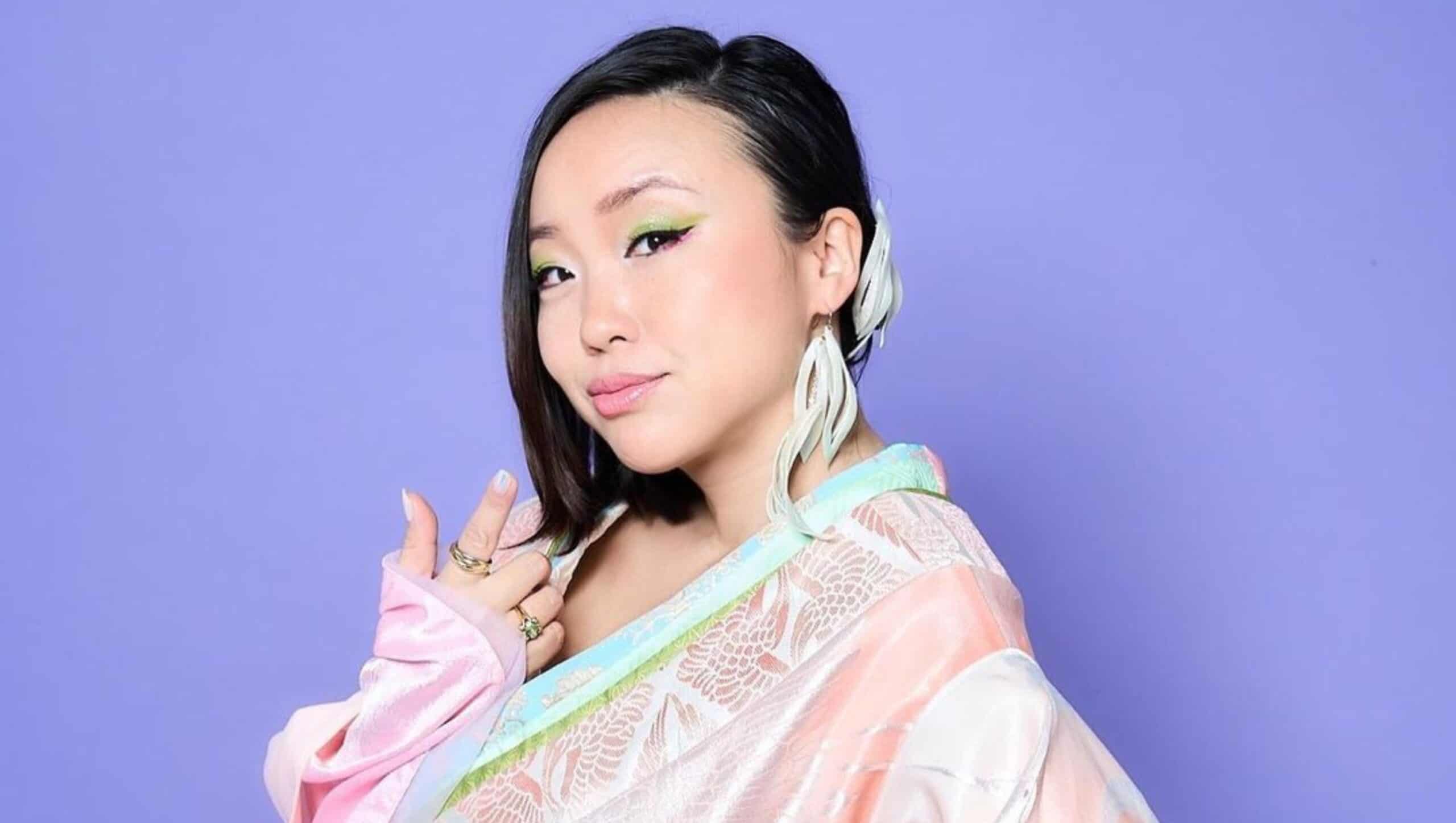
In 2005, at the Ryogoku Kokugikan sumo arena, a rapper reached the final of the B-Boy Park’s MC Battle, the biggest rap competition in Japan at the time. No woman had ever made it that far. The arena’s rules, which traditionally barred women for ritual reasons, had to be debated on the spot by the organizers. They ended up letting her compete, on one condition: she had to take off her shoes so as not to defile the ring. COMA-CHI faced off against Shinpeita barefoot, in front of hundreds of spectators who’d come to watch men, and finished second. Twenty years later, she remains one of the most respected figures in Japanese hip-hop and one of the few to have weathered every shift in the genre without ever releasing the same record twice.
COMA-CHI started out in music in junior high as a band singer. At fifteen, she discovered hip-hop through Lauryn Hill and Mary J. Blige, then moved toward more conscious rap with Nas, Common, Talib Kweli, and Mos Def. Japan in the early 2000s wasn’t exactly welcoming ground for a woman who wanted to rap: in the interview she gave Tokyophonic in 2020, she describes a time when a girl picking up the mic would just get laughed at. She didn’t see it as a fight, more as a provocation she enjoyed. She likes doing what other people don’t. Her breakthrough at the 2005 B-Boy Park MC Battle changed everything. Her debut album, Day Before Blue, came out the following year, carried by the track “Michibata,” which has since become a classic of Japanese rap. The features started pouring in: m-flo, Daichi Miura, Miliyah Kato, ZEEBRA. Her answer to RHYMESTER’s “B-Boy-ism“, titled “B-Girl-ism“, went straight into the genre’s hall of fame.
The major label, the break, and the move to independence
In 2009, she signed to a major label and released RED NAKED, which topped the download charts. She racked up film soundtrack and commercial work. But the experience didn’t last. As she explains to Tokyophonic, working with a major meant answering to a whole team, following a commercial direction built around the “COMA-CHI concept“, far from her own artistic instinct. She found herself surrounded by people more focused on numbers than on creating, and felt her own drive to express herself fade out, little by little. She broke her contract after two years and founded her own label, Queen’s Room, in 2011. The timing turned brutal-fast: a month after leaving the major, the Tōhoku earthquake struck Japan. Invited to perform in a disaster-stricken area, close to the damaged nuclear plant, she played with no electricity at all, just drums and acoustic instruments. The experience left a deep mark on her. She says she suddenly felt uneasy about the very idea of relying on electricity, after seeing what its failure could cause. That’s where her more organic sound was born, one she dug further into on the album Golden Source.
2013 marked the birth of her daughter. Around the same time, she appeared on Reggae Connection, Sly & Robbie’s album, which earned her a Grammy nomination and a seat at the awards ceremony in Los Angeles. In 2018, after several years spent raising her daughter and delving into her own roots, she released JOMON GREEN, centered on the Jōmon period, Japan’s prehistoric era. The track “Water”, co-written with American producers close to Kendrick Lamar and Snoop Dogg, has her rapping entirely in English. “The Voices of Kamuy“, drawing on Ainu culture, was picked up by Marvel for the anime Hit-Monkey. In her Tokyophonic interview, she frames this whole pursuit as a need to reconnect with an original kind of energy, the one she says can be felt in the patterns, art, and music of the Ainu, Ryukyu, or Australian Aboriginal peoples, rather than as some exoticism she’s chasing.
OTO, bridges to New-York and Paris
Her latest album, OTO, came out in May 2024. It pushes even further into the fusion of hip-hop and neo-traditional Japanese folk, with traditional instruments front and center. In April 2025, she was invited by the Japan Society in New York for a public conversation alongside koto player ASUKA and Brooklyn-based producer MeccaGodZilla, titled “Japanese Hip Hop: A Cross-Cultural Conversation“. The event confirmed a collaboration with MeccaGodZilla that had started earlier, one already touched on in an interview she gave RJHH in June 2022 around the track “Spiritual Bitch“. In that interview, she goes back to how the collaboration started: MeccaGodZilla had lived in Japan ten years earlier, discovered her music, came to her shows, and has held on to the idea of working with her ever since. The connection happened through a mutual friend, Akko, right as he himself was looking to collaborate with artists from around the world during the pandemic. She also explains the project’s title there: two sides of herself, the sacred and the raw, the spirituality and the straight talk she picked up from hip-hop, which she refuses to treat as opposites.
On June 21, 2024, for the Fête de la Musique, COMA-CHI played her first-ever concert in France, at the Maison de la culture du Japon in Paris. The evening, organized in partnership with Real Japanese Hip Hop, put her on stage alongside Namichie, a rising voice of the younger generation, with DJ Sonikem on the mix. The day before, she took part in a panel on women in Japanese hip-hop, alongside Chiharu Chujo (a lecturer at Université Jean Moulin Lyon 3) and ATTANGO, founder of Real Japanese Hip Hop. A Paris stop that extended, on the other side of the world, the same kind of cultural bridge-building she’d go on to do a year later in New York with ASUKA and MeccaGodZilla.
Astrologer, teacher, and still independent
Outside of music, COMA-CHI has taught at Kyoto University of Art and Design and practices horoscope astrology along with guided meditation. Since April 2025, she’s also been part of the teaching staff at GROOVE MUSIC ACADEMY, Japan’s first school dedicated to hip-hop and R&B, based in Kita-Aoyama, Tokyo. There, she trains rappers and singers alongside MUMMY-D of RHYMESTER in a program that covers everything from vocal technique to songwriting to hip-hop culture itself. She remains on her own label, Queen’s Room, which she’s run since 2011, with no interest in going back to a major-label setup. Asked, in the RJHH interview, what makes her happy in this line of work, she answers simply: watching a song born out of her own need to express herself take shape, reach people, and hearing them say it gave them courage or joy. Everything else, she says, is just the price of being on stage.
Now listen to our playlists on Spotify!
Updated every two weeks