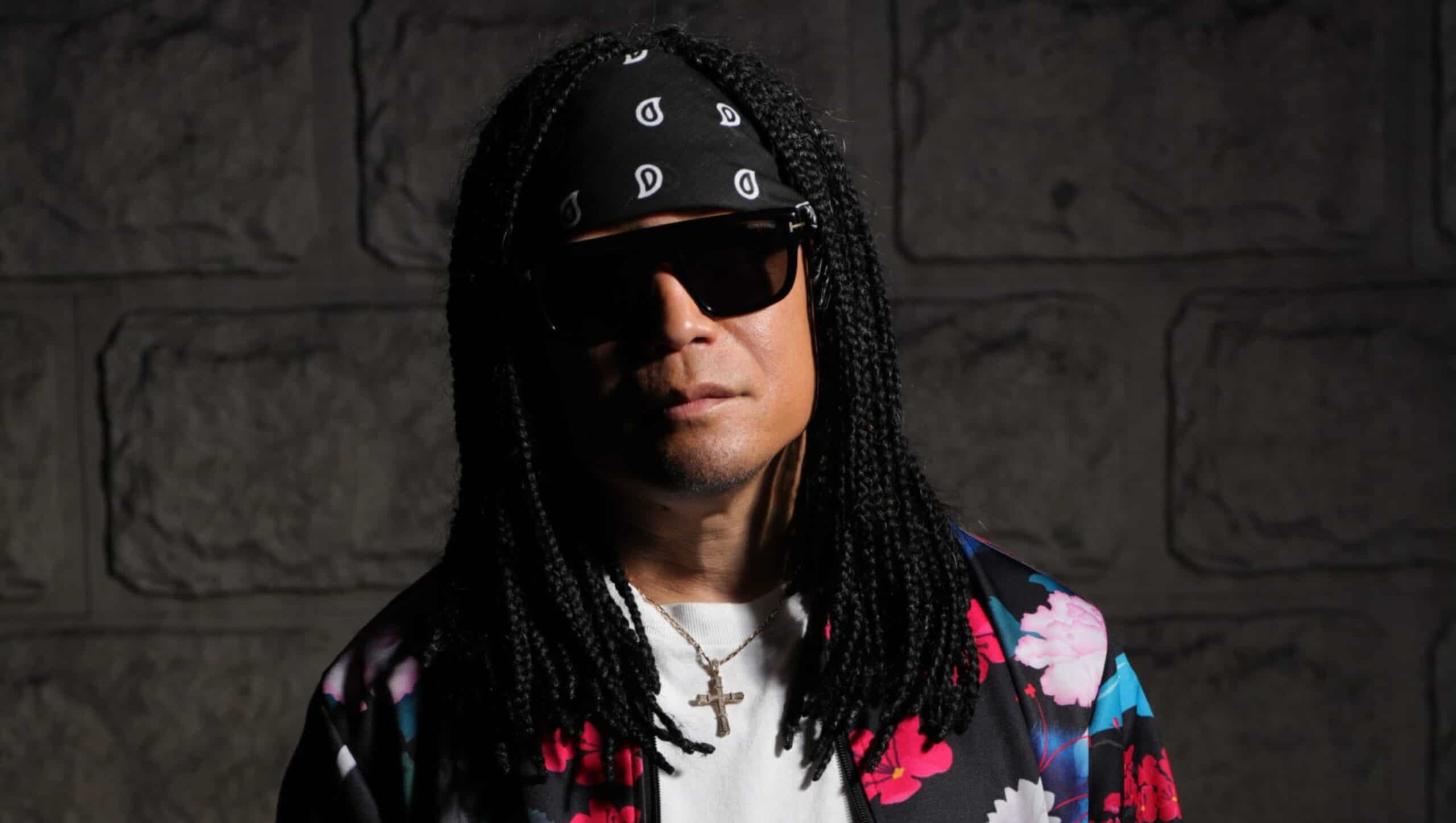
DJ PMX needs no introduction at this point. The sheer volume of work he’s put out in recent years speaks for itself. Some still see him as the man who brought G-Funk to Japan. Others know him as a producer with a firmly mainstream sound. For the past few years, the DJ and producer from Miyazaki has been getting louder attention, riding the wave of the hip-hop sound currently sweeping the globe. Curious about this shift in direction, RJHH sat down with him to talk through his ambitions and what’s coming next.
Hello, DJ PMX, thanks for sitting down with us. Most of our readers probably already know who you are, but can you introduce yourself in a few words?
DJ PMX: Hello, everyone. I’m DJ PMX, a Japanese hip-hop producer. I got my start in hip-hop in the late 80s. I’ve spent time watching the music scene from both the outside and the inside.
Let’s start with your most recent project with Diablo, “AIM HIGH,” now out on CD and digital. Can you tell us more about it?
DJ PMX: I met Diablo in 2013 at an event called MINORITY in Yamagata. A few years later, we crossed paths again to work on a compilation, and we stayed in touch after that. When I dropped the single “Something New” last summer, the response was positive, which pushed us to start working on the “AIM HIGH” EP. This summer, we also put out a “Something New” remix featuring DJ☆GO and Gipper. We’re working on a new EP right now. The energy is good.
Diablo is a young artist, and it looks like your work is leaning toward this new generation of rappers. Do you think these newcomers are the future of Japanese hip-hop?
DJ PMX: Watching the excitement around this new generation of rappers in the US pushed me to pay closer attention to the young rappers here at home. I went to a lot of shows with younger artists around Tokyo, and I noticed some of them bringing something new, whether in energy or in quality. I think this is the right moment to find new talent. I’m rooting for Diablo, who stays active despite a tough geographic situation. He’s based in Sakata, in Yamagata Prefecture. The same goes for Daia, who moved from Okinawa to Tokyo and already managed to sell out the prestigious CLUB ASIA.
You made your first beats in the 80s, and thirty years later, you’re still here. What’s the secret to staying active this long?
DJ PMX: Hip-hop keeps evolving, constantly. If you look at how music evolves not just over a few years but over a long stretch of time, you’ll see it for yourself. I track hip-hop’s evolution in full years, not just a few months at a time, and that’s what lets me understand how to approach my next projects. The West Coast movement in Japan is just one example among many. I don’t think you should fear change. You need to adapt to it, or things get complicated fast if you want to keep going.
What pushed you toward beatmaking? And what would you have done if you weren’t in music?
DJ PMX: I’m not just a beatmaker. I’m a DJ and a producer. I shape the artist’s flow, the content too, and I get involved in music videos and social media. If I weren’t in music, I think I would have been bored a long time ago.
Even though G-Funk hasn’t been part of your recent work, you can still hear its influence on tracks like Kowichi’s “Everyday’s Flyday” or Daia’s “Freeway.” Do you think G-Funk is dead for good?
DJ PMX: For me, the G-Funk era is over. You can see it clearly: the new generation isn’t interested, because at parties and events, barely anyone shows up for it. I was genuinely into that sound back when it ruled the hip-hop scene, but these days it’s a 90s classic, and it’ll stay one, even if there are some great tracks in there. I’ll always draw inspiration from the West Coast sound, but more from whatever’s dominant right now.
How do you see hip-hop’s evolution? Is making a beat today different from making one 20 years ago?
DJ PMX: Twenty years ago, in the early 2000s, original compositions started picking up compared to the New York sampling style. Today’s trap sound is kind of an evolution of that 80s Def Jam and Tommy Boy sound, especially in the drums and synths. Those elements originally came from genres like techno or pop, just more concentrated. Back then, beatmakers used the TR-808 to build beats. That same TR-808 now exists as a virtual instrument. I think filter manipulation and digital tools have made all of that more practical to use. As for me, I always keep that 90s hip-hop and R&B atmosphere, while adapting it to whatever’s moving today.
You’ve released several singles under the DBL Music label. Can you tell us about it?
DJ PMX: I have always wanted to build my own studio and label. For a few years now, I’ve been producing certain artists under my label. The next albums will also be released through DBL Music in partnership with a major. In my case, my name carries enough weight that no label will stop me from putting out projects.
For the past two or three years, you’ve been more active than ever. You’re making beats, dropping singles and EPs, and you’ve gotten into directing music videos too. Are you trying to expand your skill set?
DJ PMX: Video is an essential tool for an artist’s development and promotion. It’s something I care about more and more, and it’s only going to matter more once 5G arrives in 2020. From composition and programming to recording and mixing, I really enjoy mastering every tool involved in music production. I think the only thing left for me to try is rapping itself (laughs).
Given Japan’s talent, how do you explain the continued limitations in collaborations with international artists?
DJ PMX: I really think language is the main barrier keeping Japanese artists from breaking out internationally. It’s a massive problem, and it’s not going away anytime soon. Even when the connection between artists from different countries is strong, listeners don’t seem fully interested in foreign artists, especially from here. It’s the same story across Asia. It’s going to take time before our artists export more. Until then, we don’t have a choice but to push ourselves and do better than everyone else. Artists from different countries need to take a real interest in each other’s musicality, so the collaborations that come out of it actually make listeners want to follow along.
You announced on social media that a new “THE ORIGINAL” series is coming soon. Can you tell us about it?
DJ PMX: I’m thinking of releasing something for spring 2020, but I can’t say too much right now. Some people ask me about “The Original III,” why it sounds the way it does, since the sound is different from the previous albums. Some artists from the new generation, after appearing on that album, went on to become pillars of today’s Japanese hip-hop scene. I think it’s important to stay in step with your era, to properly close out one that’s run its course. Maybe “The Original III” came a bit early for some people. I’m thinking of launching a new “The Original” series, one that’ll be a real fresh start this time.
When you work on an EP like Diablo’s “AIM HIGH”, do you direct the artist from start to finish, or do you just make the beats and let them take it from there?
DJ PMX: First, we pick the instrumentals; then the content and the flow come next. I usually arrange the melody after that. It depends on the artist. Sometimes the artist already has a pretty clear idea in mind.
2019 has been a huge year for you, with productions for artists like Daia, K.O. feat. Iamsu!, One-G, Ashura Mic, and more. How do you explain that level of demand, and what sets you apart from other producers?
DJ PMX: I think what sets me apart from other producers is that I manage to adapt over time while staying rooted in that West Coast hip-hop vibe. Hip-hop keeps changing, and I find that genuinely interesting. I never get tired of it.
What are your own favorite productions?
DJ PMX: I’m especially fond of my most recent work, “The Original III” above all.
Your sound and style have evolved over the past few years. What artists inspire you today?
DJ PMX: There’s no one specific artist right now. I keep up with new releases through the site Young California. A few years back, I was drawing more inspiration from DJ Mustard and Ty Dolla Sign.
Thank you so much for this interview, DJ PMX. We can’t wait to hear what you do next. Any final words?
DJ PMX: Make sure to check my site for all upcoming releases. A new “THE ORIGINAL” series is coming, along with productions for artists like Gadoro, Halogen, Diablo, and Daia. I’m also opening up opportunities to mentor university students on music production. Stay tuned. Thanks, everyone.