
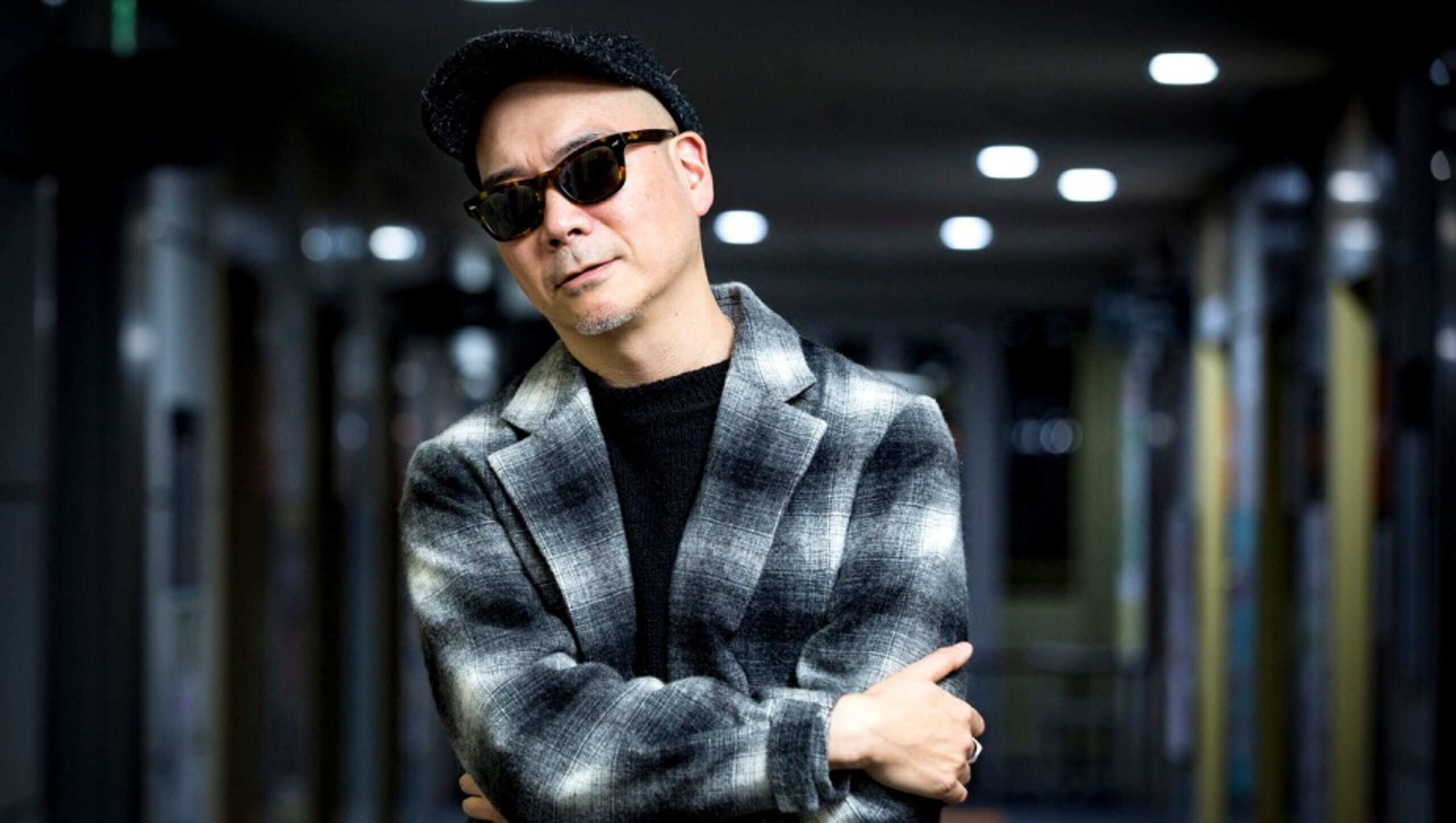
Utamaru came through Paris in April 2024, invited by the Maison de la Culture du Japon à Paris (MCJP) to give a talk on his careers. The timing lined up almost perfectly: just two months earlier, his group RHYMESTER had marked its 35th anniversary with a show at the Nippon Budokan, one of Japan’s biggest venues, built around two of their landmark albums, “RESPECT” and “MANIFESTO“. RHYMESTER, formed in 1989, is the oldest hip-hop group in Japan still active today, and Utamaru has been one of its defining voices from the start. He’s also a radio host, a film critic, and a writer, which gives him a rare, wide-angle view of Japanese pop culture as a whole. RJHH caught up with him on the sidelines of his Paris visit to talk through how he found hip-hop, how Japanese rap found its own voice, and the two RHYMESTER tracks that came to define a generation.
Can you introduce yourself to readers who don’t know you yet? Tell us about your beginnings in hip-hop.
Utamaru: My name is Utamaru, and I’m part of the rap group RHYMESTER. I can say RHYMESTER is the oldest Japanese rap collective still active today. This year, we’re celebrating our 35th anniversary. I record albums with the group, I tour, and I perform live. At the same time, I host a radio show, I write film criticism, and I’m also an author, so I hold a slightly “ambiguous” position in the music world, since I wear a lot of hats. I lived through and watched what happened in Japanese rap in the 80s, 90s, and 2000s, so I’m here to speak to that too, and to talk about what got me into hip-hop in the first place.
How did you first encounter hip-hop?
Utamaru: I was born in 1969, so the 80s were my teenage years. You could already hear rap music in discos early in that decade. But hip-hop specifically, I’d say it really arrived in Japan in 1983, with Flashdance. That’s the film where Japanese audiences first saw the Rock Steady Crew, the New York B-boy team, and where the general public here discovered hip-hop dance. Wild Style mattered too. Japan was the first country to release that film theatrically, and it pushed breakdance even further into public view.
But at the very beginning, rap itself remained within a comedy framework. People used it for sketches. There was a radio show called Snakeman Show. You can find it as an album now, but at the time, it was a radio program, and they’d built sketches around rap recorded on tape. It wasn’t music yet. It was more of a comedic gimmick. One of the people behind it had picked up the idea from a New York rapper who’d come through Japan: with no sampler available, he looped a tape of “Good Times” and rapped over it live. That was Japan’s first taste of hip-hop rapping on record, but it stayed a novelty.
Around the same time, RUN-DMC was getting big and starting to break through in Japan, and a lot of our seniors, people who’d come up through punk and counterculture, decided it was time to pay attention to rap. I was personally more drawn to Ito Seiko. There was also a rock musician, Motoharu Sano, who spent a year and a half in New York and returned with an album titled “Complication Shakedown.” He rapped on it, but he stayed rooted in rock, and nothing really followed from that record.
We had this whole wave of people we admired, Ito Seiko, Hiroshi Fujiwara, Kan Takagi, and Haruo Chikada, who were drifting toward hip-hop. So we told ourselves the same thing: this culture is incredible, this is a new era, let’s get into rap. Around that exact moment, new regulations forced big discos to close earlier, and they started losing ground. Smaller, underground clubs sprang up to fill the gap. Those clubs played everything: hip-hop, reggae, house. And since they didn’t have house DJs yet, they ran constant competitions to find them. That set off a real movement, with musicians and artists all trying to break through at these small-club contests. Before RHYMESTER, that’s where I spent my time, and I remember Scha Dara Parr was already a known name in that exact scene.
When I started university, I wanted a hobby that would deepen my understanding of Black music and hip-hop, but there was no club for it. I eventually found one called Galaxy, focused on Black music: soul, blues, R&B, though the senior members there leaned more toward scratching and DJing. New members were expected to do some kind of performance to introduce themselves. The seniors asked me to do a comedy sketch. I refused, and instead rapped in the English I had at the time. They were skeptical going in. They didn’t think a Japanese person could ever really inhabit rap, in English or in Japanese. They had too much respect for Black music to let just anyone touch it. When I actually rapped, they were stunned. That reaction is what told me I could keep going. Right after that welcome session for new members, I started entering competitions at the small clubs.
“During that year, while the track itself wasn’t locked, I kept building the lyrics in my head, bit by bit. It’s the only song in my whole career I wrote without ever putting pen to paper.”
I started competing in English-language rap battles, and people told me I had real talent. I began pulling friends together for more events, and that’s how a group called B-FRESH came together, later renamed B-FRESH POSSE: MC BELL, DJ KRUSH, MURO, DJ BEAT, DJ SEIJI, and CAKE-K. CAKE-K mattered a lot here. At the time, rappers were still trying to find a rhythm that worked in Japanese. He was the first person to tell me you had to find Japanese words that actually sat well inside an English-style rhythm. I remember him telling me, point-blank, to drop the English raps and rap entirely in Japanese. Watching him pick Japanese words that locked into an American flow, I realized I could do the same thing with my own vocabulary; it’s the vocabulary that matters, and you have to know how to swap words for the right synonyms. I had enough of a base to do that. Japanese rock musicians had faced the same dilemma years earlier, leaning English inside Japanese-language rock before eventually settling into rock that was purely in Japanese. Japanese rap went through that same phase. I started out as a solo rapper. By my second year at university, Mummy-D had joined as a freshman.
Let’s go back to two songs that came up earlier. “B-Boyism” and “Once Again” are two of RHYMESTER’s most popular tracks. Can you tell us what they mean to you, and what they represent in the group’s story?
Utamaru: “B-Boyism” closes out what you could call the first chapter of the Japanese hip-hop story we’ve been talking through, the part where the underground scene starts pushing aboveground. It came out of an event called Sapporo Champ Camp, which was bankrolled by Avex, a huge company. Avex’s own artists, BUDDHA BRAND, ECD, were the headliners, so it was a massive event. But for us, it felt like a turning point: the era when we’d all pushed the scene forward together as one was ending, and from then on, it would be everyone fighting their own battle.
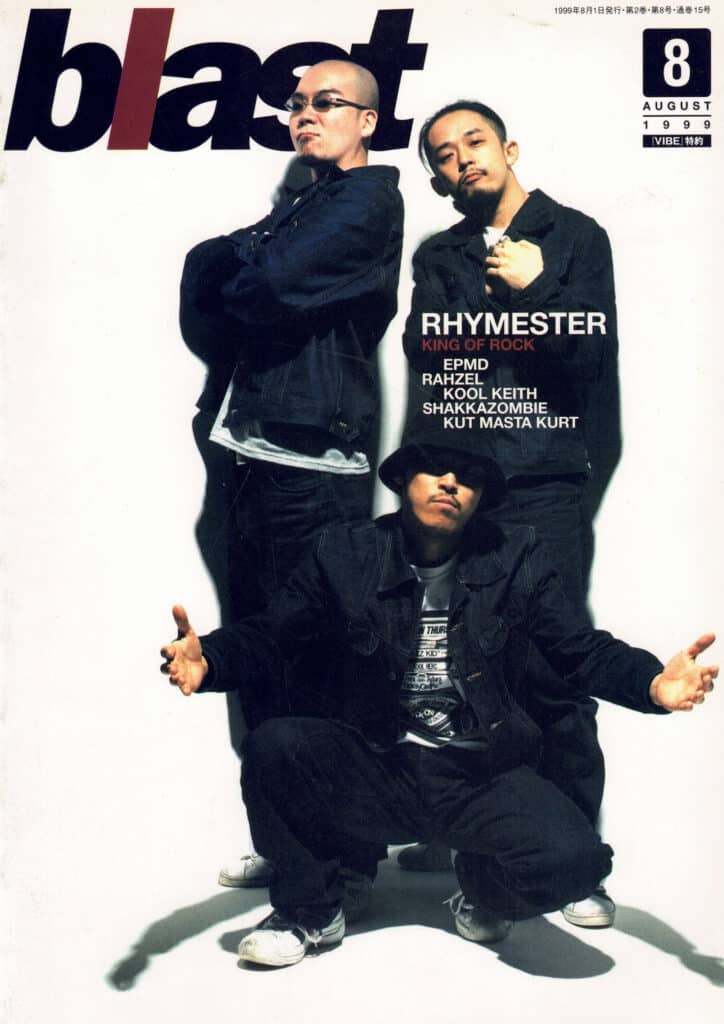
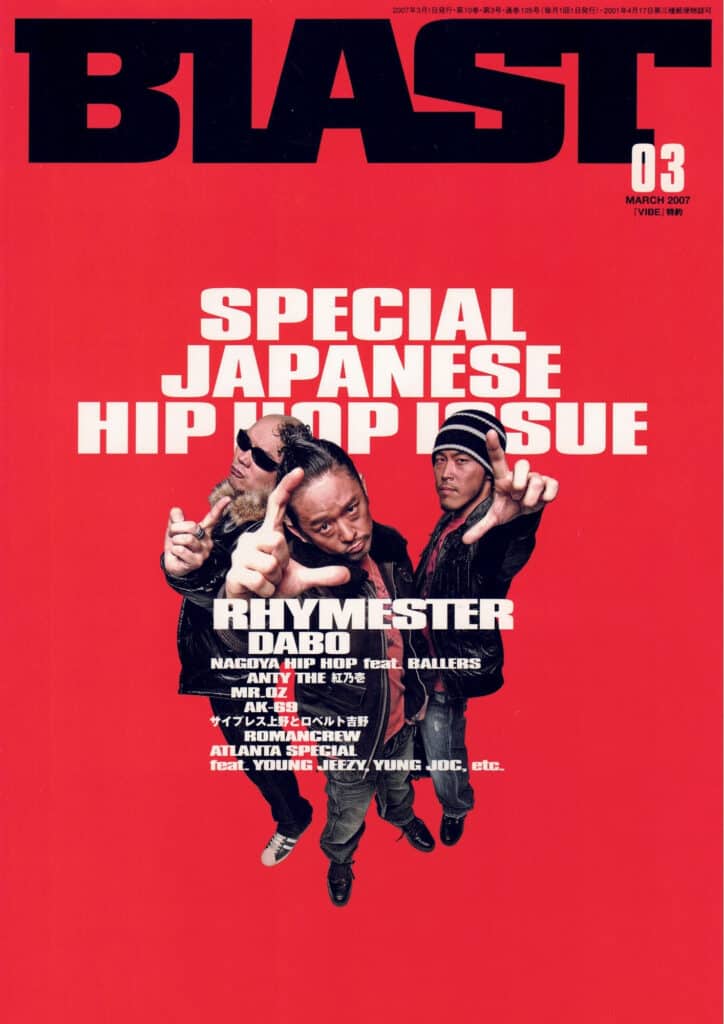
At that same event, we performed a song called “Mimi wo Kasubeki” (“You Should Lend an Ear”) for the first time, the first track we’d ever made that we were 100% satisfied with. It’s become a Japanese hip-hop classic in its own right. That was 1996. Back then, releases moved slowly. It took about a year to finish a single track. After that, the question became what to release next, and that’s where “B-Boyism” came in. The title plays on “hip-hop-ism”. I had a column in a specialist magazine called Blast where I connected all kinds of subcultures, film, literature, figures, whatever, back to a hip-hop sensibility. The column was literally called “B-Boyism.” So the song title was a kind of media crossover, taking something I’d built in print and turning it into a track.
We landed on the idea that breaking, breakdancing, was the purest expression of hip-hop’s spirit, since it’s built for movement, for the beat. We made a beat that was a little faster than what was trending in hip-hop at the time, and it was genuinely difficult to finish; it took a full year. During that year, while the track itself wasn’t locked, I kept building the lyrics in my head, bit by bit. It’s the only song in my whole career I wrote without ever putting pen to paper. By the time we got to the actual recording, the entire thing was already memorized.
Like I said, it landed a bit ahead of where hip-hop trends were at the time, and it was an unusual track. But once it came out, it became one of the defining songs of our generation. If you asked people to name one hip-hop classic from our generation, it’d be either “B-Boyism” or “Jinrui Hatsudensho” (“Human Power Plant”). It became one of the defining records in Japanese hip-hop. It lined up perfectly with the breaking scene’s momentum at the time (B-Boy Park, the judged breaking battles) and with a broader global return to old-school values. It turned into a genuine scene anthem. Every club I walked into, it was playing. Everyone could sing along.
In that column you mentioned, what kinds of subjects did it cover, beyond figures and film?
Utamaru: Movies, books, all kinds of scattered subcultures, really. I actually wanted to make it into a proper specialized publication at one point. What I had in mind was something like The Source, the hugely respected American hip-hop magazine of that era. The Source didn’t just cover music; it had sections connecting all sorts of culture back to hip-hop. I think I was basically trying to do something similar for Japan. Everything I do on the radio now is essentially “B-Boyism,” just in a different format.
The track itself came out the year after “Mimi wo Kasubeki,” correct?
Utamaru: That’s right. “Mimi wo Kasubeki” came out of Sapporo Champ Camp, an event that bridged the underground scene and the official, Avex-backed side. Avex Trax had ECD and BUDDHA BRAND on its roster, which made an event of that scale possible. Sapporo Champ Camp became hugely well-known, but it also felt like the end of something underground. From there, we knew we had to go find our own lane to protect what we were doing.
“B-Boyism” came out in 1997. The BPM actually went past 100, which was fast for the time; the standard hip-hop tempo back then sat in the 90s. In the studio, people were genuinely asking if it was too fast, too unusual. But other label artists who happened to be in the studio that day told us to keep it exactly as it was, and once it came out, the reception backed them up completely.
Other label artists were just in the studio while you recorded?
Utamaru: Yes, that’s how it was. People from other crews would constantly be around during someone’s session. The scene was tightly connected. If word got out that someone was recording, people would just show up. We were genuinely close to each other. There’s actually a KGDR (King Giddra) line that ended up on the track. We needed a sound sample and didn’t have it on hand, so someone said King Giddra was recording nearby, went over, and just borrowed it on the spot. That kind of thing was completely normal.
We were also close with the breaking community, specifically, the B-boys and B-girls. “B-Boyism” became something close to a symbol for them. Plenty of dancers have battled to that track over the years. It’s an older-generation record by now, nothing like what the trap generation listens to, but it still gets programmed almost systematically whenever international playlists feature five or ten Japanese hip-hop tracks. It’s become a real reference point internationally.
“We set a much higher bar: lyrics had to land with anyone, hip-hop fan or not, as real pop songwriting, no more leaning on genre as an excuse.
When I was a student, I used to watch MTV at a friend’s house, and there was a show called Yo! Raps that did a Japan-focused segment. That’s actually how French audiences first heard Japanese hip-hop: through clips on MTV in the early 2000s, before YouTube existed and people started finding more footage that way.
The “B-Boyism” music video features many people. The first version we shot wasn’t good, so we scrapped it and reshot it quite a while later. By then, Shibuya was the center of the Japanese hip-hop scene, so we put the word out through record stores there: come shoot a video outside the open-air stage tomorrow night. Word spread the day before, and a huge number of hip-hop heads and artists who knew each other showed up. Everyone sang along together. You can spot KREVA in there; Sakura and Rico both show up, too. ZEEBRA‘s somewhere in the footage as well. Back then, everyone filmed each other’s videos and recording sessions as a matter of course, so it’s genuinely hard to tell who’s who in some of that footage. Different crews, sometimes rivals, but everyone still got along.
Let’s talk about “Once Again.” How does that one compare?
Utamaru: After “B-Boyism,” we felt like we’d done everything we could with where we were at, skill-wise, and RHYMESTER went on hiatus. During that break, I started my radio career, which proved to be well received in its own right. Mummy-D worked on a duo project called Maboroshi with guitarist Tomoyasu Takeuchi from the funk band Super Butter Dog. DJ JIN ran a jazz-hip-hop unit called Breakthrough. We each kept busy separately. We paused activity in 2007 and returned in 2009, and “Once Again” was the first thing we released upon our return.
Two years is a long gap, and new artists kept emerging throughout, so there was real pressure. We also completely changed how we worked. Until then, DJ JIN and Mummy-D had produced every track themselves. This time, for the first time, we brought in an outside producer, Bach Logic, because hip-hop production had become far more complex and codified than it had been in the 90s; it had reached a level where you genuinely needed a specialist, not someone doing it on the side. Bach Logic was right at the cutting edge of sound at that point, so we went to him, and what he sent back became the foundation for the track.
Coming back after the hiatus, knowing we weren’t young anymore and might already feel out of step with the times, we turned that anxiety into the song itself, almost a pep talk aimed at ourselves. What was genuinely different this time was the process: we’d each write our verses, then Mummy-D would step back and look at the whole thing, almost like a creative producer, flagging lines that didn’t read clearly and pushing for revisions. We’d go back and forth, “this part doesn’t land,” and I’d respond, reworking lines rather than assuming “it’s hip-hop, it’s fine as is.” We set a much higher bar: lyrics had to land with anyone, hip-hop fan or not, as real pop songwriting, no more leaning on genre as an excuse.
The sound changed just as much. We’d always worked with low, raw, sample-driven 90s textures. This was suddenly hi-fi, synths cutting through cleanly, a real shift in direction, and we expected pushback for it. Instead, it turned into another defining song almost instantly, an anthem status all over again. Other rappers started posting their own verses over it online in a remix style, which aligned perfectly with the moment Twitter was taking off; everyone was posting their own lyrics, pushing “Once Again” everywhere and turning it into something close to viral. That first comeback single landing that hard is a big part of why the comeback itself worked, and honestly, why we’re still going today. “B-Boyism” and “Once Again” both always make it into a RHYMESTER setlist. People come specifically to hear those two. They sound nothing alike, but together they’re the two songs that define what we do.
ALSO IN RJHH
Artists • Bunka • Interviews • News • Videos