At first glance, hip-hop culture and Japanese animation seem to move on two parallel tracks, separated by an ocean of cultural difference. Yet for decades, these two worlds have been watching each other, answering each other, quoting each other. Out of that dialogue come hybrid works where the usual borders blur: an alloy of asphalt and paper, of urban beats and the line work of Japanese animation. That meeting has produced some real pieces of contemporary pop culture. You’ll find B-boys and MCs borrowing the aesthetics of samurai and ninja, graffiti that comes alive like pages from a shōnen manga, flows that unfold with the precision of a brushstroke mid-battle. Welcome to a world where Japanese animation and hip-hop talk to each other in rhymes and color, where rap becomes the soundtrack to a meeting between two cultures that’s still evolving.
SAMURAI CHAMPLOO, THE PERFECT FUSION
Created by Shinichirō Watanabe, Samurai Champloo remains, hands down, the most iconic crossover between hip-hop and anime, “the ultimate intersection of anime and hip-hop“, as fans describe it. The story follows a wandering samurai named Mugen who, after escaping a public execution with the help of two strangers, Jin and Fuu, sets out to find the “samurai who smells of sunflowers.” What sets the show apart is its deliberately anachronistic world: this Edo-era Japan makes room for graffiti, rap battles, and a lo-fi sound that recalls 90s mixtapes. The soundtrack, composed by Nujabes and Fat Jon, became a cult favorite well beyond anime circles, with a sound that continues to shape beat-making today. The show opened the door to a whole generation of hybrid works that no longer hesitate to freely mix cultural references.
AFRO SAMURAI, REVENGE IN RHYTHM
Following in Samurai Champloo’s footsteps, Afro Samurai pushes the fusion between the two worlds even further. The show tells the story of a Black man trained in a martial arts dojo who, after witnessing his father’s assassination, sets out on a quest for revenge. A violent story that handles racial identity and the fight for honor with real nuance. Produced by Studio Gonzo, the series features Samuel L. Jackson’s voice and a soundtrack composed by RZA of Wu-Tang Clan. The accompanying album, generally cited as “The RZA Presents Afro Samurai: The Soundtrack“, blends rap, raw hip-hop beats, and traditional Japanese textures, amplifying the show’s visual dimension. Afro Samurai plays like an artistic manifesto celebrating the fusion of the Black American and Asian worlds: as its creators put it, it’s a love letter to hip-hop and anime communities everywhere. The character, with his towering afro and his katana, embodies that meeting of two distant cultures all on his own.
THE BOONDOCKS, BEYOND BORDERS
Widening the lens a bit, The Boondocks deserves a place in this conversation. Often left out of the strict category of Japanese anime, this American show shares enough of its visual codes to have earned a Japanese dub. Technically, The Boondocks isn’t an anime in the strict sense: the show is produced by Sony Pictures Television, through its subsidiary Adelaide Productions, an American outfit, not a Japanese studio. What is true, though, is that Japanese studio Madhouse contributed uncredited animation work on the series starting with season two, alongside Korean studios like MOI Animation, which is itself owned by Madhouse. That technical link, more than the production itself, explains the visual kinship with anime. The show stands out for its sharp critique of American society, mixing political satire, soul music, and constant hip-hop references. With frequent appearances from rappers and American rap celebrities and a soundtrack steeped in jazzy, soulful beats, it’s sometimes hard to tell whether the show is celebrating hip-hop culture or critiquing it. That ambiguity is exactly what gives the show its richness and its worldwide audience.
KILLER BEE, THE FIRST RAPPING NINJA
Even mainstream shōnen franchises aren’t immune to hip-hop’s pull. Case in point: NARUTO and its character Killer Bee. Despite his impressive skills as a ninja, his real passion is becoming the greatest rapper the world has ever known. This colorful character, who mostly expresses himself through improvised rhymes and constantly jots his lyrics into a notebook, brings a real jolt of freshness to the show’s already rich world. Killer Bee, a true “rapping ninja“, embodies the spirit of rap culture: self-affirmation, creativity, freedom of expression. His off-kilter freestyles and MC poses recall 90s rap figures like Ol’ Dirty Bastard or Busta Rhymes. Through this character, NARUTO’s creators wove hip-hop into a ninja fantasy world, proof that this urban culture can fit into narrative settings far removed from its origins.
MEGALOBOX, THE SPIRIT OF SURVIVAL IN RHYTHM
On a grittier note, MEGALOBOX stands out as another landmark in this relationship between hip-hop and Japanese animation. Through well-placed hip-hop melodies, the show captures the harsh fight for survival in a world that wasn’t built for its hero’s success. The story of Junk Dog, an underground boxer grinding through fixed fights before getting his shot at a prestigious tournament, speaks directly to the struggle of those living on the margins, echoing the “rise from nothing” stories so common in rap. Like plenty of MCs before him, Junk Dog has to build an identity, survive rejection, and make his name in a world trying to erase him. The soundtrack, mixing jazzy samples with lo-fi textures, rounds out that urban atmosphere and builds a coherent world where sports aesthetics meet street culture. “Slum City“, by mabanua feat. COMA-CHI stands out for its raw power, a track that carries the pain of a forgotten world and the strength of those who refuse to disappear quietly. In Japanese, COMA-CHI spits a cold truth about social exclusion: “no identity, no name, no past or future, only the present”, “the only entertainment is MEGALOBOX, when one destroys the other”. MEGALOBOX speaks to rap fans as much as it does to combat sports fans.
KENGAN ASHURA, SAME ENERGY, SAME RAGE
We leave MEGALOBOX’s underground boxing scene for the corporate ultra-violence of Kengan Ashura, where big companies settle their disputes with their fists, in secret arenas. Kengan Ashura is a martial arts action series written by Yabako Sandrovich and illustrated by Daromeon, published in Japan between April 2012 and August 2018. Its anime adaptation, produced by Larx Entertainment, started streaming on Netflix in 2019. For anyone who lives and breathes hip-hop, it’s impossible not to see a parallel with an MC’s journey to make their voice heard. Through the main character, Ohma Tokita, a solitary fighter with a mysterious past, you feel the same intensity as a rapper climbing from the underground into the spotlight. Every fight becomes a battle, every round a verse balanced between rage and precision. One track captures that energy well: “Born This Way“, released in 2019 by the group BAD HOP, with rappers Bark, Yzerr, and Vingo, was used as the season one ending theme. An anthem for anyone who doesn’t apologize for being born in the arena, its lyrics carrying the pride of an accepted fate: 「俺らは生まれた時からこうなんだ / Born this way」, “we’ve been like this since birth.” Kengan Ashura and hip-hop share a common thread: turning violence into style, pain into power, and the street into a stage.
TOKYO TRIBE 2, THE STREET IN ITS PUREST FORM
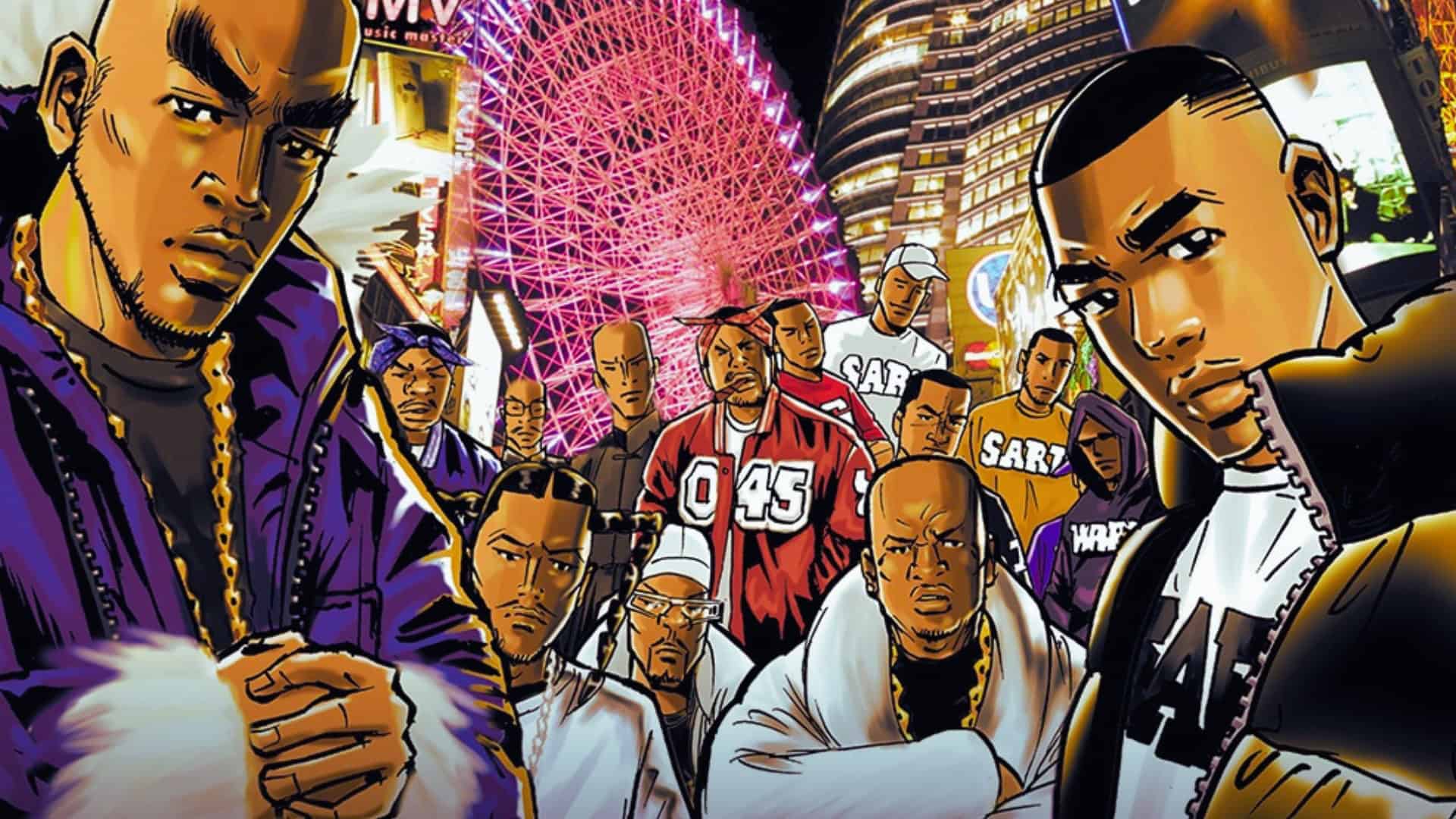
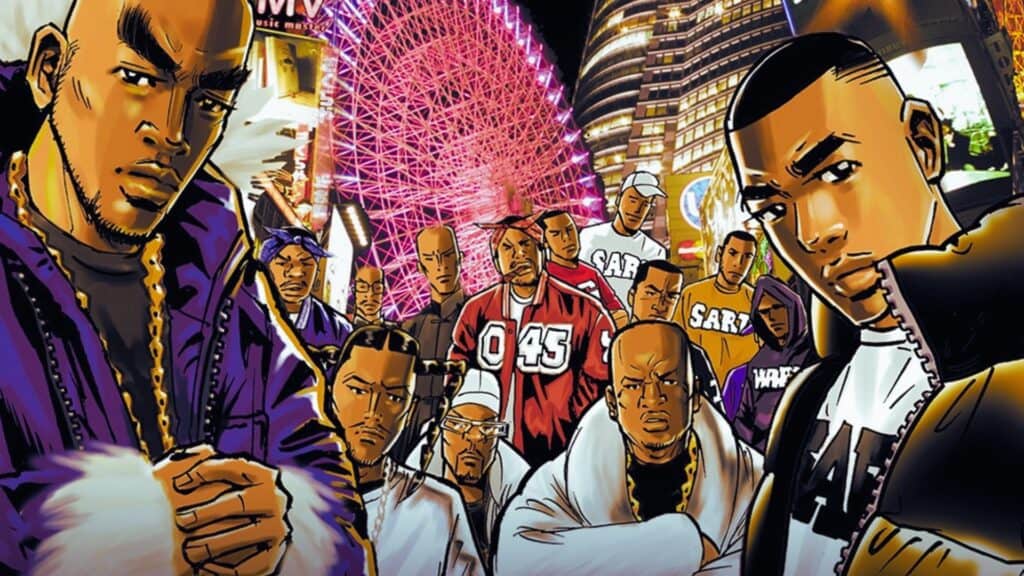
Adapted from Santa Inoue’s manga, Tokyo Tribe 2 is probably one of the “streetest” anime ever made, built around turf wars, gang warfare, and underground rap battles. Airing between November 2006 and February 2007 and produced by Studio Madhouse, the series runs 13 episodes. It mostly follows Kai, a DJ and member of the Musashino Saru, in a crossover between The Warriors and Boyz N The Hood filtered through Tokyo, where hip-hop’s codes are everywhere: territory, verbal clashes, a hierarchy built on respect, a distinctive dress code. All of it is set in a futuristic Tokyo where each district is controlled by a “tribe”. Tokyo Tribe 2 is probably the most literal example of hip-hop woven into Japanese animation: rap isn’t just a stylistic influence here; it drives the narrative itself. The soundtrack, handled by Muro, a legend of Japanese beat-making, brings together Japanese rap names like Suiken, Big-O, S-word, and Twigy, alongside American rap heavyweights Ghostface Killah and Raekwon of Wu-Tang Clan. The track “TOP OF TOKYO“, performed by Illmatic Buddha MC’s, serves as the opening theme and stands as the soundtrack’s most iconic cut, a classic that captures the show’s raw spirit.
AKIRA, THE FOUNDING WORK
No exploration of this crossover would be complete without Akira, a founding work in the relationship between Japanese animation and hip-hop culture. Akira pays only minor direct tribute to hip-hop itself, but the film became a major source of inspiration for the genre and the culture as a whole. Katsuhiro Otomo’s visionary work has shaped the imagination of countless hip-hop artists, from Kanye West, whose “Stronger” video is a direct homage, to Travis Scott. It’s cyberpunk aesthetic, its motorcycle chases through a post-apocalyptic Tokyo, its vision of rebellious youth up against an authoritarian power: all of it resonates with hip-hop sensibilities. In Japan, Akira’s world has shaped a whole generation of rappers emerging from the underground scene, right up to more recent artists. You’ll find the same codes: crew mentality, late-night runs through the city, rage against the system, chaos as a playground for expression. Akira’s influence also reaches into streetwear, with brands like Supreme and Bape releasing collections inspired by the film, and into street art, where images of Tetsuo or Kaneda on his red motorcycle have become go-to visual references, reworked, remixed, screen-printed, and tattooed. Akira remains the symbol of an urban Japan, loud, restless, in flux, a vision born in the 80s that still feeds the aesthetic and attitude of hip-hop culture, on walls and in beats alike.
Best Japanese Hip Hop Albums of 2026 — Vol. 2
Hip-Hop and Anime: Where Japanese Culture Meets Rap
10 Best Japanese Rap Albums of the 2000s
Best Japanese Hip Hop Albums of 2026 — Vol. 1
Shibuya-kei: The Rhythmic Legacy of an Eclectic Revolution