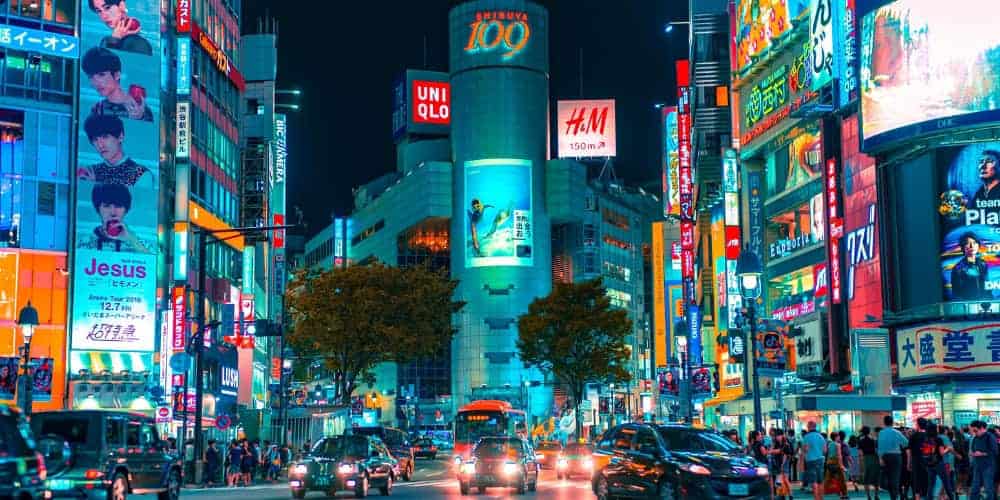
Tokyo, Japan | by ATTANGO
Shibuya-kei usually gets filed under pastel pop. Sixties string arrangements, French yé-yé vocals, sleeve art borrowed from Italian design annuals. That reading is not wrong, but it skips the part that explains how the records were actually built. Most were assembled from breakbeats, and several people in the scene came straight out of Tokyo’s first hip-hop generation. What follows is an attempt to trace that line properly, with sources, because it is the half of the story that rarely travels outside Japan.
The Name Came From a Record Shop, Not the Artists
The earliest documented use of the phrase appears in a November 1993 article in apo magazine by Jiro Yamazaki, asking what this “music of downtown” actually was. By then, HMV Shibuya, open since 1990, had already set up a Shibuya Recommendation section curated by distribution manager Hiroshi Ohta. The label stuck because a shop put it on a shelf. The naming came late. Flipper’s Guitar had debuted in 1989. Pizzicato Five were already several albums deep. Sabukaru suggests the construction was borrowed from visual-kei, which had surfaced the year before. Either way, the scene ran for four or five years before anyone agreed on a name for it.
Shibuya in the early nineties had an unusual density of import shops within a few hundred meters. Manhattan Records opened in April 1980 and built its name on affordable imports; it is also the shop Tokyo’s rap DJs used. Zest had been in the Records Building since 1986, specializing in neo-acoustic and guitar pop. HMV and Tower on Udagawachō filled in the rest. The consequence is geographic rather than ideological. A producer hunting a sixties Brazilian pressing and a DJ hunting a clean copy of a funk break were in the same building, the same week, buying from the same staff. The two scenes never needed an introduction. What came out of those shops was not curation; it was digging: the same practice a rap producer uses, transferred to pop. Pizzicato Five in particular built a catalog by excavating and reusing, record after record.
Look at the Drum Tracks
The clearest evidence is not in the interviews; it is in the credits. Flipper’s Guitar’s “Groove Tube” (1991) runs on “Amen, Brother” by The Winstons. Pizzicato Five’s “Baby Love Child”, released the same year, uses James Brown’s “Funky Drummer”. Cornelius’s “Mic Check” (1997) uses Graham Central Station’s “The Jam”. Those aren’t obscure picks. The Amen break and Funky Drummer are the two most heavily used drum breaks in recorded hip-hop. Choosing them in 1991 wasn’t eclectic. It was a producer reaching for exactly the same two records every rap producer on the planet was reaching for. What changed was the arrangement stacked on top. The title of “Mic Check” deserves a second of attention too. Cornelius named a track after a rap convention and built it on a funk break. Whatever else Fantasma is doing, it is not hiding its sources.
Major Force Is the Seam
Major Force was founded in 1988, and Red Bull Music Academy describes it as Japan’s first imprint devoted entirely to dance music. Its founders were Toshio Nakanishi, Gota Yashiki, Masayuki Kudo, Hiroshi Fujiwara, and Kan Takagi. Nakanishi’s route in is well documented. He heard “Planet Rock” on New York radio in 1981 and saw Afrika Bambaataa at the Peppermint Lounge. Before that, he fronted Plastics, who released through Island in 1981, and he worked as a graphic designer, including material for Talking Heads. He co-owned Pithecanthropus Erectus, one of Tokyo’s early club venues. We covered that period in detail in our piece on how rap reached Japan.
Fujiwara and Takagi had formed Tiny Panx in 1985. The name came from Malcolm McLaren, who used it for Fujiwara at Vivienne Westwood’s World’s End shop, and they spelled it with an anarchist A. They rapped in English and Japanese, ran the Last Orgy column, performed with the Beastie Boys, and stopped around 1990. Their album Constructive, made with Seiko Ito, is called one of the most important records of early Japanese hip-hop by Red Bull Music Academy. So by the time a magazine coined “Shibuya-kei”, the five men who built Japan’s first dance label were already circulating through the same twenty streets. That overlap is the part most write-ups miss.
Kon’ya wa Boogie Back Is the Proof
Scha Dara Parr came out of the same bubble-era Tokyo, openly influenced by the Beastie Boys, and Red Bull Music Academy credits them with a sound and a lyrical register nobody in Japan had used before. In 1993 they turned up on De La Soul’s Buhloone Mindstate, rapping in Japanese and English on “Long Island Wildin’”, which is about as direct a New York endorsement as any Japanese group got that decade.
Then came 1994 and “Kon’ya wa Boogie Back” with Kenji Ozawa. Ozawa was one half of Flipper’s Guitar. Red Bull Music Academy reads the track as an examination of the distance between Japanese and American hip-hop, which is generous but not wrong. It was also a very large hit. It remains the clearest single artifact of the two scenes being one scene: a rap trio raised on the Beastie Boys and the ex-guitarist of the band that started Shibuya-kei, on the same record. We placed Scha Dara Parr’s 1991 debut in our anthology of Japanese rap for the rap side of that story. This is the other side.
The Beastie Boys Kept Showing Up
One thread runs right across both decades, and it is easy to miss because it sits in the credits of American records rather than Japanese ones.
Tiny Panx performed with the Beastie Boys in the late eighties, before Grand Royal existed. Ten years later, the label the Beasties founded had become home to artists from the same Shibuya orbit. Buffalo Daughter debuted on the Japanese indie label Cardinal in 1994. Luscious Jackson heard them while touring Japan and passed their tapes to Grand Royal, who signed them in 1996; Captain Vapour Athletes (1996) and New Rock (1998) came out through the label. Cibo Matto signed to Warner Bros. for Viva! La Woman (1996), but Yuka Honda and Miho Hatori stayed in the Grand Royal orbit, running Butter 08 as a side project while Honda produced Sean Lennon’s Into the Sun. Hatori sang on “I Don’t Know”, on the Beastie Boys’ Hello Nasty, in 1998.
AllMusic describes Honda’s work on those records as funk samples, hip-hop rhythms, tape loops and fractured pop melodies, in that order. The production was hip-hop production. The vocals went somewhere else entirely. Several of the artists filed under Shibuya-kei have rejected the label for their own work, Buffalo Daughter among them. That is consistent with where the word came from. It was retail shorthand before it was anything else, which is part of why it covers such an odd spread of records.
Whisper Rap, and Where the Line Actually Sits
Worth being blunt about the limits. Shibuya-kei did not make rap records. It made pop records with rap tools. The whisper rap running through Kahimi Karie’s catalog and much of Pizzicato Five’s is a vocal texture, not an MC performance, and treating the two as equivalent flatters nobody.
The better accounts keep that distinction. Sabukaru gives Scha Dara Parr as the movement’s hip-hop dimension rather than claiming the whole scene for rap, and names Nobukazu Takemura’s jazz and hip-hop hybrids as the influential bridge. The breaks were hip-hop. The voices, mostly, were not. It is also fair to say some of the sampling was tourism. Records got lifted for their surface, and the credits did not always follow. That criticism has followed Shibuya-kei since the nineties, and it still applies to parts of the catalog.
Pizzicato Five and the Move Into Jungle
Pizzicato Five’s own arc shows the rhythmic drift. The group started in house and lounge territory and kept pulling in harder material. Under Yasuharu Konishi, they moved through drum’n’bass and jungle, which changed the pace of the writing. “It’s a Beautiful Day” runs fast jungle breaks under exaggerated soul, and the gap between that rhythm and the group’s pop imagery is the whole point. “Ice Cream Meltin’ Mellow” sets sixties string writing against an assertive hip-hop rhythm. Overdose (1994) pushed the logic further, with full rap verses over club beats.
The golden age closed quickly. By the mid-nineties, several of the central acts had split or moved on, and Cornelius’s Fantasma (1997) reads as the late peak rather than the start of anything. The retail floor went with it. HMV Shibuya, the shop that put the word on a shelf, shut its flagship in August 2010 after twenty years of trading. The causes were structural rather than musical. The aesthetic got absorbed by the mainstream. Listening moved to portable players and away from shop counters. Shibuya’s role as the center of youth culture passed to Akihabara, and the scene lost the retail floor it had been built on.
The Line to Now
What survived is the method. Barriers between genres in the current J-rap and alternative pop scene are thinner than they were in 1993, and that is partly inherited. STUTS, an MPC player and full producer who now works with singers from that era such as Taeko Onuki, is a direct descendant. So is a chunk of the bedroom pop scene, where AOTO and lilbesh ramko work the same logic of collage and domestic experimentation. Shibuya-kei was less a sound than a way of working: dig obsessively, take the rhythm section from hip-hop, put anything at all on top. Whether through the vinyl releases of DJ CHARI & DJ TATSUKI or the hybrid compositions of STUTS, that habit is still audible. To see where the rap side went next, see how rap built its own culture in Japan.
Sources:
- sabukaru: Stereophonic Sound Spectacular, a deep dive into Shibuya-kei (origin of the term, the record shops, Scha Dara Parr, Nobukazu Takemura)
- In Sheep’s Clothing: The Samples Behind Your Favorite Shibuya-Kei Tracks (Groove Tube, Baby Love Child, Mic Check)
- Red Bull Music Academy: Toshio Nakanishi interview (Major Force, Plastics, Planet Rock, Pithecanthropus Erectus)
- Red Bull Music Academy: The Birth of Hip Hop in Japan (Scha Dara Parr, Kon’ya wa Boogie Back, Hiroshi Fujiwara, Tinnie Punx, Constructive)
- sabukaru: Shaping the Japanese Hip Hop Scene, Tiny Panx (Fujiwara, Takagi, Last Orgy, Beastie Boys)
- Los Angeles Philharmonic: Buffalo Daughter (Cardinal, Luscious Jackson, the Grand Royal signing)
- AllMusic: Cibo Matto (Viva! La Woman, Butter 08, Yuka Honda’s production)
- Billboard: Beastie Boys’ Hello Nasty at 20 (Miho Hatori and Sean Lennon on the record)
- Billboard: HMV Japan to Shutter Flagship Store (the closure of HMV Shibuya)
- Neo-Japonisme (W. David Marx): The Best of Shibuya-kei
- Yokogao Magazine: Shibuya-kei
- Photo by Jezael Melgoza on Unsplash
Artists · Interviews · Videos
22 Japanese Rappers to Know in 2026
Best Japanese Hip Hop Albums of 2026 – Vol. 2
Hip-Hop and Anime: Where Japanese Culture Meets Rap
10 Best Japanese Rap Albums of the 2000s
Best Japanese Hip Hop Albums of 2026 – Vol. 1